
Flexible warehouse automation: why it is important and how to plan for it

Within an industrial landscape of changing needs and rapid change, it is important for production to be able to adapt to new production realities. For this reason, it is essential to make the warehouse flexible and capable of supporting expansions and changes.
The main objectives of this implementation are: to improve the efficiency, accuracy and speed of logistics operations, thereby enabling companies to better manage inventory and logistics and save time and resources.
Flexible industrial automation employs several technologies, including:
- Automated inventory management systems,
- Automated picking and packing systems,
- Autonomous vehicles for moving goods,
- Collaborative robots for material handling.
Integrating them into business processes makes it possible to adapt to changes in demand and work volumes, such as quickly scaling up operations during periods of high demand or scaling down during periods of low activity, without interrupting or stopping the production line.
In this article we look in detail at why it is important to make the warehouse flexible by employing automation and how to plan for its implementation.
The importance of flexible warehouse automation
Today’s market moves on changing consumption trends. Classic “rigid” warehouses with static, predefined configurations are unable to face with changes in demand or production volumes.
In contrast, intralogistics solutions that combine automation and flexibility enable dynamic and strategic adaptation and modification of warehouse operations to respond to changes in inventory, production, and the market.
In fact, all of this makes it possible to adjust storage capacity and product handling speed according to changing needs, and avoids overloading or underutilization of resources while maintaining a high level of service.
Automating the warehouse also makes it easier to implement new layouts, reconfigure production lines, and adopt new processes, without having to make significant changes or incur reconversion costs.
This flexibility is based on the following concepts:
- Modularity: self-contained modules or components that can be easily added, removed, or rearranged to adapt to changes in activities or operations.
- Programmability: plant scheduling allows customization of behaviors and functions.
- Data integration: data, coming from different sources, are collected and processed to optimize performance.
- Interoperability: automated systems communicate and collaborate with each other seamlessly and synergistically.
A flexible warehouse thus provides several benefits, including:
- Increased efficiency and optimization of operations,
- Elasticity and adaptability to market demands,
- Reduction of errors.
Flexible automation through stacker cranes and miniloads
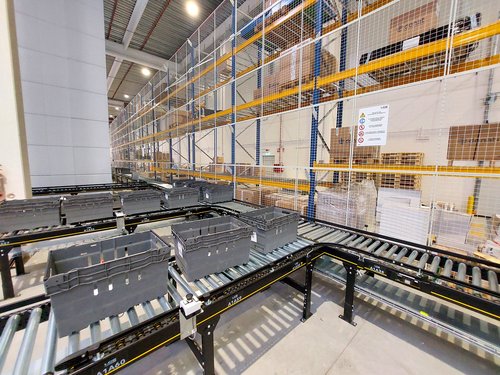
As learned so far, flexible warehouse automation is a key concept in the modern logistics industry. Specifically, stacker cranes and miniloads represent two automation solutions that play a central role in this context.
Stacker cranes are machines capable of moving heavy loads quickly and efficiently, providing optimized space management. Miniloads, on the other hand, are compact, highly automated systems that enable automated storage and retrieval of products in containers or totes
With technologies such as stacker cranes and miniload systems, it is possible to improve operational efficiency, reduce errors, and optimally manage inventory. The flexibility of these automated systems is critical to adapt to changing warehouse needs, ensuring optimized workflow and intelligent space management.
How to plan flexible warehouse automation
Dealing with the planning of a warehouse, making it flexible and responsive to changes, means taking several aspects into consideration:
- Adaptation to changes in demand, reviewing flows and operations and considering in advance possible expansions (e.g., new production lines or increasing storage capacity);
- Optimization of operations, with the goal of maximizing overall warehouse efficiency;
- Management of contingencies (e.g., anomalies or breakdowns);
- Priority management;
- Integration with enterprise systems, integrating the WMS that manages automatic/semi-automatic or manual warehouse with other enterprise systems, such as ERP;
- Performance monitoring and analysis, so that areas for improvement can be identified;
- Maintenance scheduling.
All these elements are part of the industrial warehouse automation development phase, which is carried out by preparing a feasibility study. This analysis summarizes customer requirements and needs, as well as the technical characteristics of the warehouse. Factors such as business growth prospects, product needs, storage characteristics, work cycles, number of automated equipment, and personnel working in the installation are also considered.
Starting from the feasibility study, flexible warehouse logistics automation solutions are then designed to best suit the specific business processes. Considering needs and demands, LCS Group defines suitable and high-performance solutions that enable customers to cope with production changes with peace of mind and ease.
LCS Group: flexible warehouse automation tailored to the customer’s needs
For over 30 years, LCS Group has offered complete solutions for intralogistics and industrial automation. Our plants and software are always tailor-made: in fact, we want to provide customers with intelligent automation that can be easily customized and modified to meet the challenges of a dynamic and ever-changing work environment.
In every project, we start from the needs of our customers, their facilities and their production; we constantly engage with them at every stage, from layout definition to implementation, to make sure that every solution we propose brings a real added benefit to productivity and business operations. Our flexible warehouse automation follows several steps:
- Business needs assessment,
- Data analysis and feasibility study,
- Definition of the design and layout, which must be approved by the client,
- Implementation of hardware and software parts,
- Installation commissioning,
- Startup of the plant,
- After-sales support and maintenance.
We thus help our customers make the warehouse more adaptable and improve its efficiency: contact us for more information.


